



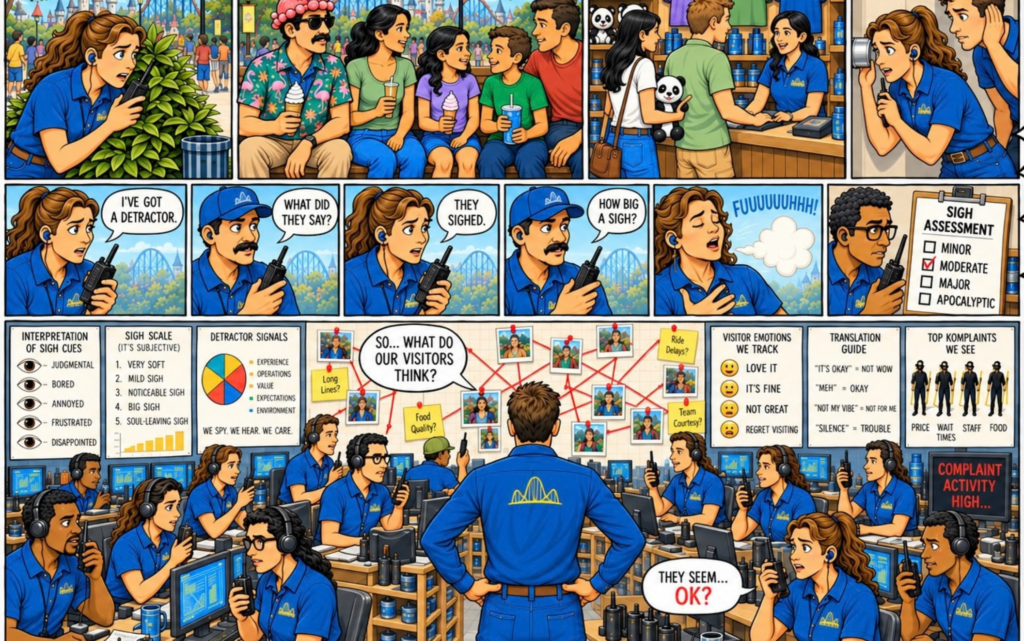
Looking beyond individual reviews to uncover patterns across the visitor experience
Your visitors are talking about your operation every day. They are talking about the line at the entrance, the employee who went out of their way to help, the cold coffee, the confusing signage and the moment that made the entire trip worthwhile.
And venue operators are listening. They read reviews, respond to complaints, monitor survey results, and share visitor feedback with their teams. The harder question is what happens next.
Is a comment simply one visitor’s experience, or is it a signal of something happening across your operation?
Recognizing that difference becomes increasingly difficult when feedback is spread across thousands of reviews, surveys, emails, and other channels. An isolated complaint can be easy to dismiss, while a recurring issue can be difficult to recognize when it appears in different words, at different times, and alongside otherwise positive experiences.
That was one of the central ideas explored during The Visitor Has Entered the Chat, a session at accesso;s dedicated client conference accesso Next focused on how Voice of the Visitor can turn unstructured visitor feedback into operational intelligence.
Because a review isn’t just a review. Buried inside it may be several different signals about how your operation is performing.
A five-star review can still contain a problem
Consider the visitor who says the attraction was incredible and an employee was wonderful, but also mentions an hour-long security wait, an overcrowded ferry and cold coffee.
Was the experience positive or negative?
A traditional review dashboard might give you one answer based on the visitor’s star rating. But that rating can obscure much of what happened. Inside that single review are several distinct experiences:
- Core experience: positive
- Staff interaction: positive
- Security wait: negative
- Crowding: negative
- Food and beverage: negative
That is why deconstructing reviews matters. Rather than treating the entire review as positive or negative, Voice of the Visitor analysis can break free-form feedback into individual remarks and examine the topic, sentiment, emotion, complaint status, potential risk and other attributes associated with each part of the experience.
The review stops being a score and becomes a map of the visitor journey.
One comment tells you something. Patterns tell you where to look.
If one visitor says the coffee was cold, should the food and beverage team change something? Maybe. If dozens of visitors mention cold coffee across several weeks, that’s a different signal.
Useful reporting needs to move beyond what did this visitor say? and start asking:
How often is this happening? When and where is it happening? Is it getting worse? Who is affected? Is it within our control? And is there something we can reasonably do about it?
That’s the value of turning qualitative feedback into structured information. Teams can move from individual anecdotes toward patterns they can investigate.
It also introduces an important consideration: consistency.
Two employees can read the same review and interpret it differently. Multiply that across thousands of reviews, surveys, emails and other sources, and those differences can change what leadership believes visitors are experiencing.

Don’t just count friction. Understand how it compounds.
One of the most thought-provoking findings discussed during the session was what happens when friction begins to accumulate. A visitor can experience one problem and still have a fantastic day. They may even leave a five-star review. But friction doesn’t necessarily behave in a straight line. Benchmark data showed a cascading effect as problems accumulate, with a notable decline appearing around three friction points. That raises an even more interesting operational question:
Which combinations of friction are doing the most damage?
A long line may be tolerable.
A long line with poor communication is harder.
Add heat, nowhere to sit and a confusing handoff, and the visitor may no longer perceive those as separate inconveniences. They experience one disappointing day.
Understanding those combinations can be more useful than simply identifying the most frequently mentioned complaint.
It can also change the solution. Eliminating the line itself may be difficult or expensive. Improving communication, setting expectations before arrival or adding shade and seating could reduce its impact.
The goal isn’t always to eliminate friction. Sometimes it’s to keep friction from cascading.
Context can change what the visitor is telling you
Reviews tell you what visitors experienced. Operational data can help explain why. If complaints about crowding suddenly increase, what else was happening?
Was attendance unusually high?
Was part of the venue closed?
Was staffing lower than planned?
Did weather push visitors indoors?
Was there a special event nearby?
Connecting visitor feedback with ticketing, point-of-sale, attendance and other operational information helps teams investigate those relationships instead of simply cataloging complaints.
The same thinking applies to pricing. If visitors repeatedly say food is expensive, the immediate reaction might be to reconsider price. But benchmark data suggests that sometimes price isn’t the problem until other friction points begin to erode the visitor’s perception of value.
That creates a very different operational challenge. Lowering the price may not fix it. Improving the experience might.
Is it a venue problem or a visitor expectation?
Context also needs to extend beyond your own operation. Suppose 8% of your reviews mention food pricing. Is that high? Without a benchmark, you don’t know. Comparing feedback against relevant industry and visitor benchmarks can help distinguish a venue-specific problem from a broader expectation or trend. It also changes the questions teams can ask. So instead of asking “Are we improving?”
Try asking: How do we compare? What are visitors increasingly sensitive to? And are their expectations changing faster than our operation?
What should Voice of the Visitor reporting tell you?
Star ratings and NPS can still provide useful signals, but they shouldn’t be the whole report.
Effective Voice of the Visitor reporting should help teams understand topic, sentiment, emotion, frequency, severity, actionability, friction, operational context, benchmarks and trends.
And don’t overlook what’s going right. Repeated praise for a particular employee, process or moment is operational intelligence too. It tells teams what is working and what may be worth replicating. The objective isn’t simply complaint management. It’s experience management.
Intelligence still needs judgment
AI creates an opportunity to analyze visitor feedback at a scale that would be difficult for venue teams to accomplish manually. But scale shouldn’t be confused with certainty.
Language is messy. Sarcasm exists. Cultural differences matter. Context matters. Some venues also operate in environments where a simplistic positive-versus-negative interpretation may be especially inappropriate.
Technology can surface patterns, prioritize issues and help teams investigate thousands of comments. Human judgment still matters, particularly when deciding how to respond publicly or what action to take.

Listening is only valuable when it changes something
Ultimately, a dashboard filled with sentiment scores doesn’t improve the visitor experience. The opportunity is to connect what visitors say with what the operation knows and determine what the team should do next.
Sometimes that means fixing a recurring problem or recognizing an employee. Sometimes it means changing pre-arrival communication and, at other times, discovering that the issue everyone assumed was the problem isn’t the problem at all.
Your visitors are already telling you what the experience feels like. The real question is whether your organization is equipped to hear the whole story.
What are your visitors telling you?
Your visitors are telling you exactly what matters most. Discover insights from more than 2.5 million AI-analyzed visitor remarks that reveal what drives satisfaction, what quietly damages loyalty, and where your organization has the greatest opportunity to improve. Read the research and see how your visitor experience compares with industry trends.
Download the Voice of the Visitor 2026 Industry Benchmark Report