



Ski Area Management’s 2025-26 Technology Survey is worth more than a quick read. It is a direct window into what ski resort operators are experiencing right now: where their investments are going, where their frustrations live, and where they see the biggest opportunity to close the gap. We found the results worth responding to, because what operators are saying maps closely to what we hear from resort teams every season.
The headline is optimistic. Eighty-five percent of respondents say their technology budgets have increased over the last three years. Nearly two-thirds rate technology as strategically important to their organization. Pandemic-era digital investments are paying dividends, and resorts are leaning in further rather than pulling back.
But underneath that confidence is a consistent, structural tension, one that shows up in the friction data, the open-ended comments, and the investment priorities alike. The problem is not capability. It is connectivity.
The Architecture Problem
The survey’s most telling finding is not a single number. It is the combination of two.
Forty-nine percent of respondents say they use a best-of-breed approach to technology, meaning different vendors for different functions. Among extra-large resorts, that number reaches 86%. At the same time, the top two sources of day-to-day system friction are vendor limitations (37%) and integrations (24%).
More vendors, more capability, more integration burden.
One large resort respondent put it plainly in the open-ended comments: “We collect significant amounts of operational data, yet there is no unified system that integrates across the resort to keep and analyze this data.”
Another, from a medium-sized area, described a stack that includes F&B, spa, mountain, and lodging systems that do not talk to one another, “limiting our ability to provide a comprehensive experience and comprehensive CRM.”
These are not isolated complaints. They are the predictable consequence of a best-of-breed environment that has grown faster than the integration infrastructure supporting it. Each vendor solves their piece well. The problem is the spaces between them, where data gets lost, where the guest’s identity fragments across systems, and where your team spends hours reconciling information that should have been unified from the start.
The survey confirms that resorts understand this. When asked where future technology investment should focus, “improving system integration and data flow between departments” ranked first, cited by 54% of respondents. That is not a coincidence. It is the industry naming its own architectural challenge
The Guest Experience Gap
The second-highest future investment priority, at 52%, is enhancing guest self-service and mobile experiences. It is worth noting that 55% of respondents say they already have a mobile app or guest portal. The issue is not absence. It is depth.
Most resort apps today give guests access to conditions, trail maps, and maybe a link to purchase. What guests increasingly expect, particularly the millennial and Gen-Z cohort that represents the next decade of reliable skier visits, is something more. They expect to plan, book, modify, order, and navigate their visit from one experience, the same way they manage everything else in their digital lives.
The data supports this. Sixty-six percent of millennial skiers prefer to book all trip components on mobile. Seventy-four percent of Gen-Z and millennial skiers use mobile to research and plan trips. And the investments resorts report as most measurably impactful, RFID and access control (24%), e-commerce platforms (22%), and point-of-sale and payments (19%), are all united by a single theme: reducing friction at the moments guests decide to commit and spend.
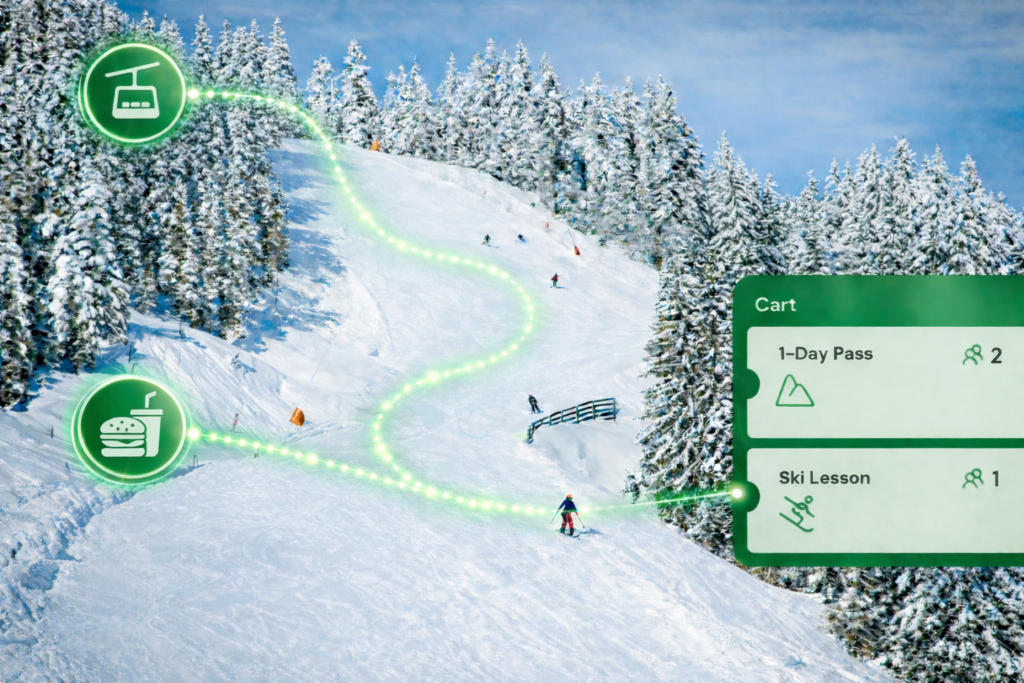
The pattern is clear. Technology investments that reduce friction in guest flow and purchasing deliver the most visible wins. The next frontier is extending that logic deeper into the visit: mobile ordering from the chairlift, real-time wait times and congestion alerts, personalized offers triggered by guest location and purchase history, and a single app that knows the guest across every touchpoint from advance purchase to après.
That is not a wishlist. Resorts that have built this connected layer are already measuring the difference. Mobile ordering has reached 35% of F&B transactions within a single season at properties that have deployed it. Guests who engage with a connected app experience show 2.8x higher repeat visit conversion rates than guests with no digital touchpoint. Real-time navigation increases on-mountain exploration and reduces friction-based guest complaints.
The gap between the app most resorts have today and the experience guests are starting to expect is real. And it is narrowing fast.
The Data Problem
Only 35% of survey respondents have a unified system for reporting and analytics across all departments. Thirty-eight percent are actively building toward one. Twenty-five percent have no centralized data strategy at all.
This is the downstream consequence of the architecture problem described above. When ticketing lives in one system, F&B in another, rentals in a third, and lessons in a fourth, there is no clean path to answering basic questions at the resort level. What did your top 100 guests spend in total across their visit? How is your food cost trending against last season? How do advance ticket sales this weekend correlate with your rental and lesson pre-booking?
Resorts with connected data can answer those questions in seconds. Resorts without it spend hours on manual exports that are already out of date by the time they are reviewed.
Future investment priority three, analytics and dashboards cited by 42% of respondents, reflects the demand for a better answer. But analytics are only as good as the data flowing into them. A dashboard built on top of disconnected systems will always require manual reconciliation. The solution is not a better reporting layer. It is connecting the underlying data at the source.
Resorts that have moved to unified platforms describe the difference in operational terms. Forecasting goes from an educated guess based on historical patterns to a real-time view of advance sales, rental pre-bookings, and lesson commitments. Staffing decisions for a busy weekend become data-driven rather than gut-driven. Month-end close for multi-lodge operations drops from a three-to-four-day manual process to under two hours.
The competitive advantage of unified data is not abstract. It changes how quickly a team can respond to conditions, opportunities, and guest behavior: on the day, in the season, and across years.
The Staffing Reality
The survey adds one more dimension that shapes how all of the above plays out at the operational level: most resorts are running lean IT teams.
Eighteen percent of respondents report having zero to one dedicated IT staff. Fifty-one percent have between two and five. That is a lot of technology complexity managed by a very small group of people, especially as budgets increase and new systems are added.
One respondent described the challenge candidly: “time and availability of staff and competing priorities” as the key obstacles to keeping systems current and maintaining forward progress on technology initiatives.
This is not a problem that solves itself by adding more tools. In many cases, adding tools without adding capacity makes the burden worse. The resorts that are making the most progress on their technology agendas are not necessarily the largest or best-resourced. They are the ones that have made deliberate choices about where to concentrate vendor relationships and where to offload ongoing infrastructure management so their teams can stay focused on the guest experience rather than system maintenance.
Managed services, whether for individual platforms or for the broader infrastructure environment, are not a default or a last resort. For lean teams managing complex stacks, they are increasingly the difference between a technology strategy that stays current and one that falls perpetually behind.
What This Means for Platform Strategy
The SAM survey does not make the case for any particular vendor or platform. But the data does make a clear case for a particular kind of architecture.
Resorts that describe the most satisfaction with their technology report strong alignment between core systems. Resorts that describe the most friction report the gaps between them. The investment priorities operators named, specifically integration, guest self-service, and analytics, are exactly the areas where fragmentation does the most damage.
For resort leaders evaluating their technology approach, the relevant question is not which vendor has the best feature set for any single function. It is which combination of platform decisions will produce the least integration overhead, the most unified guest and operational data, and the best experience for a guest who expects their mountain to know them from the moment they book through the end of their season.
That question is worth asking more directly than most technology evaluations allow for. The SAM survey gives you the data to start that conversation with clarity.
Where accesso Fits
accesso connects ticketing, F&B and retail operations, guest identity, mobile experience, and analytics in a single ecosystem: one vendor, one data model, and one point of accountability across the guest journey.
Resorts using our platform report outcomes that map directly to the gaps the SAM survey identifies:
The integration problem: Manning Park Resort eliminated 40+ hours per month in manual reporting after moving ticketing, ski school, and rental management to a single connected platform. The data across departments now lives in one place, and forecasting for staffing and inventory is driven by real-time advance sales rather than historical estimates.
The revenue and pre-purchase opportunity: Perfect North Slopes achieved a 45% year-over-year increase in season pass sales after deploying a unified pre-purchase platform. Pre-committed revenue replaced walk-up dependency, reducing weather-driven exposure and improving planning accuracy across the operation.
The guest experience and mobile gap: Mid-market resort deployments of our mobile guest experience platform have generated $30 average in-app revenue per user and $600,000 or more in seasonal revenue uplift. Gamification-driven engagement reaches 40% of app users, compared to 20% on standard apps. Repeat visit conversion rates are 2.8x higher for guests who engage through the connected app experience.
The data problem: Properties using unified reporting through our platform have reduced month-end close from multi-day manual processes to hours. F&B food cost analysis, rental inventory optimization, and cross-department performance tracking become real-time rather than retrospective.
And for operations teams running on lean IT headcount, accesso’s managed services capability extends beyond our own products, taking ownership of infrastructure management so resort technology teams can stay focused on the guest rather than the stack.
The SAM survey reflects a ski industry that is taking technology seriously and investing accordingly. The challenge now is making those investments work together. The resorts that get this right in the next few seasons will have structural advantages in guest loyalty, operational efficiency, and revenue predictability that compound over time.
If the integration, data, or guest experience gaps in the survey feel familiar, we would like to talk through what solving them looks like for your operation specifically.
If you are attending NSAA this May, come find us. We will have the full platform on display and the right people in the room to have a real conversation about where your operation is today and where you want it to go. It is one of the best settings we know of to see the platform in action and hear directly from other resort operators who have been through the same decisions you are making now.
Find accesso at NSAA in May, visit accesso.com, or contact your accesso account team to start that conversation.
Source:
SAM “Technology Temp Check,” March 2026. Survey statistics sourced from the 2025-26 SAM Technology Survey, 76 respondents. Resort outcome metrics from accesso client deployments.