



If you’ve been shopping for a new point-of-sale system, you’ve almost certainly seen vendors throw around the words “cloud-based” and “cloud-native” as if they mean the same thing. They don’t — and for operators running high-volume food, beverage and retail operations, the distinction matters more than most vendors will tell you.
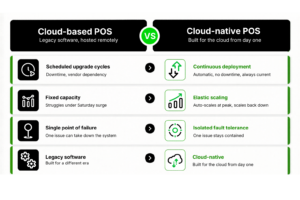
A cloud-based POS is software that has been moved to the cloud. It may have started life as a legacy, server-based product and been migrated to run on hosted infrastructure. It lives online, but it was never really designed to live there.
A cloud-native POS is built from the ground up for the cloud. Its architecture — the way it stores data, deploys updates, scales under load, and connects to other systems — is designed to take full advantage of what modern cloud infrastructure can do.
The difference isn’t just technical. It shapes how your operation performs on a packed Saturday, how quickly you can push a pricing update across every sales point in your venue, and how confidently your system holds up when it matters most.
What does cloud-based actually mean?
Cloud-based simply means the software runs on remote servers rather than on a physical machine in your back office. That’s a meaningful step forward from a traditional on-premises system, and it does deliver real benefits.
With a cloud-based system, you can access your data remotely, push some updates without sending a technician on-site, and avoid the upfront cost of buying and maintaining your own server hardware. For venues that have historically relied on legacy systems, moving to cloud-based is a significant improvement.
But cloud-based doesn’t automatically mean modern. Some cloud-based systems are legacy products wearing new clothes where the underlying architecture was never rebuilt for the cloud, just rehoused in it. That can mean slower update cycles, limited API flexibility, and scaling constraints that surface under pressure – exactly when you need your system to perform.
What makes a POS cloud-native?
A cloud-native system is architected specifically for the cloud environment. A few things set it apart:
- Microservices architecture — Instead of one large, monolithic application, cloud-native platforms are built as a collection of smaller, independent components. If one part of the system has an issue, the rest keeps running. That’s a fundamentally different reliability model.
- API-first design — Cloud-native platforms are built to connect. Open APIs mean your POS can talk to your ticketing system, loyalty program, kitchen display, mobile ordering interface and inventory tools without requiring custom workarounds.
- Continuous updates — Because the platform was designed for the cloud, updates are deployed continuously and automatically — no scheduled downtime, no waiting for a new software version, no paying for an upgrade cycle.
- True multi-tenancy — Cloud-native SaaS platforms are built to serve many clients on shared infrastructure, which means the economics of scale benefit everyone and the system is engineered to handle concurrency at volume.
- Elastic scalability — When your venue hits peak capacity — whether that’s a Saturday in July or a holiday weekend — a cloud-native platform scales resources up automatically to meet demand, then scales back down. Legacy architecture can’t do that without significant manual intervention.
Why does this matter for venue operators?
For GMs and operators running F&B and retail across attractions, ski resorts, live entertainment venues or hospitality destinations, the architectural gap between cloud-based and cloud-native shows up in very practical ways.
Peak performance. High-volume venues experience demand in bursts. A cloud-native platform built for elastic scaling handles those surges without degradation. A cloud-based system retrofitted from legacy architecture may struggle under the same conditions.
Speed of change. Want to run a last-minute happy hour promotion? Push a new menu item across every sales point before doors open? A cloud-native platform with centralized administration lets you do that in minutes, not hours. Cloud-based systems with older underlying architecture can make those changes slow, fragmented or dependent on vendor involvement.
Connected operations. The modern guest journey doesn’t start and end at the counter. It runs from pre-purchase online through ticketing, parking, entry, F&B, retail and loyalty. Cloud-native, API-first architecture is designed to connect those touchpoints. Cloud-based systems built on older foundations often require workarounds or third-party middleware to achieve the same result.
Reliability when it counts. Traditional server-based systems, and some cloud-based ones — carry the risk that a single point of failure takes down the entire operation. Cloud-native microservices architecture is built to isolate failures, so a problem in one part of the system doesn’t cascade across the whole.
How accesso Freedom℠ was built
accesso Freedom is accesso’s retail, food and beverage platform, and it was built cloud-native from day one. That distinction was intentional.
Rather than migrating an existing product to the cloud, Freedom was architected specifically for it. That means a single back-office where operators manage menus, modifiers, inventory and pricing across every sales point – fixed POS, handheld mobile POS, self-service kiosks and mobile ordering — all running on the same platform, all in sync.
Updates and promotions apply instantly across every touchpoint. New sales points can be added without infrastructure changes. And because Freedom is built on an open API, it connects to the broader accesso ecosystem — including ticketing, loyalty and virtual queuing — as well as complementary third-party tools, so guest data and operational data move together rather than sitting in separate silos.
For venue operators evaluating a new F&B and retail platform, the question isn’t just “is it in the cloud?” It’s “was it built for the cloud?”
FAQ
Q: What is the difference between a cloud-native and cloud-based POS?
A: A cloud-based POS is software hosted on remote servers, which may have originally been built as a legacy system. A cloud-native POS is designed and architected from the ground up for the cloud, using technologies like microservices, open APIs and continuous deployment that take full advantage of modern cloud infrastructure.
Q: Why does cloud-native matter for food and beverage venues?
A: For high-volume F&B and retail operations, cloud-native architecture means better performance at peak, faster updates across every sales point, and the ability to connect your POS to ticketing, loyalty and other systems without costly custom integrations.
Q: What is a venue point of sale system?
A: A venue point of sale system is a commerce platform designed for the specific demands of attractions, live entertainment venues, ski resorts, hospitality destinations and similar operators. Unlike generic retail POS systems, venue-specific platforms are built to handle high transaction volumes, complex promotions, multi-touchpoint operations (fixed POS, kiosks, mobile ordering) and connections to ticketing and guest identity systems.
Q: Can a cloud-based POS work offline?
A: Many cloud POS platforms, including cloud-native ones, offer offline or low-connectivity modes that allow critical functions to continue if internet connectivity is disrupted. Specific offline capabilities vary by vendor, so this is worth confirming during your evaluation.
Q: What should venue operators look for in a F&B POS system?
A: Look for a system that unifies restaurant and retail on a single platform, supports multiple order types (counter, kiosk, mobile), enables centralized menu and pricing management, and connects via open APIs to your ticketing and loyalty systems. Operators should also ask whether the platform is cloud-native or simply cloud-hosted — the architectural difference affects performance, scalability and your ability to adapt quickly.
Ready to see the difference cloud-native makes?
accesso Freedom was built for the cloud from day one, so your F&B and retail operation can move faster, scale smarter and stay connected across every guest touchpoint. Request a demo and see what it looks like in action.