




Secondary ticket markets are not an emerging trend. They are a mature, parallel economy that has been running alongside your primary sales for years on third-party sites, social media groups, and informal peer-to-peer exchanges. By the time a fan posts a ticket screenshot in a group chat, the revenue opportunity, the data record, and the brand touchpoint have already left your control.
Most operators understand this intuitively. What is less well understood is the cumulative cost of inaction. Individual resale transactions are small. Across a full season or event calendar, the aggregate in leaked revenue, degraded CRM data, fraud liability, and regulatory exposure is not.
The venues gaining ground on this problem are not the ones that have solved it perfectly. They are the ones that stopped treating resale as a downstream nuisance and started treating it as a structural feature of how fans behave, one that requires infrastructure, not just policy.
This piece covers what that infrastructure looks like, why it matters beyond the obvious revenue argument, and what governance actually needs to be in place for it to work at scale.
What uncontrolled resale costs you
The reflex is to treat uncontrolled resale as a post-transaction problem, something that happens after the ticket leaves the platform and therefore outside the venue’s remit. That framing is both common and costly. In practice, the damage from uncontrolled resale accumulates well before anyone tries to scan a barcode at the gate, across five compounding dimensions.
- Revenue leakage. Every resale transaction that happens outside your platform is money you don’t capture. Those fees and markups flow to third-party sites like StubHub, Viagogo, Facebook or WhatsApp and not back to your organization.
- Data loss. When a ticket changes hands outside your system, your CRM shows the original buyer, not the guest who showed up. Your marketing, loyalty programs, and audience development strategies are all built on incomplete data.
- Brand risk. Fans associate the resale experience with your event, even when it happened on a completely different platform. A bad (or expensive!) experience on an external marketplace, and the fan or guest will blame the venue.
- Fraud exposure. Without a verification layer inside your platform, duplicate tickets, ghost listings, and counterfeit barcodes proliferate. When something goes wrong at the gate, your operations team absorbs that frustration with zero visibility until it’s too late.
- Regulatory risk. In many US states, anti-scalping regulations create compliance exposure for venues even when the venue was not directly involved in the transaction. Uncontrolled resale is a liability you’re carrying without the benefit.
The industry has tried three responses to this problem: ignore it, fight it, or outsource it to external marketplaces. None of them has worked long-term, offering up the only approach that gives venues lasting control by bringing resale inside the platform.
What changes when resale runs inside your platform
Official, in-platform resale gives fans a verified way to list and purchase tickets without ever leaving your environment. The transaction happens under your brand, within the rules you define, with full ownership of the data at every step.
Here is what that shift produces in practice:
- Revenue stays in your ecosystem. Instead of flowing to third-party marketplaces, resale transaction fees generate incremental income for your organization with no additional marketing spend required to capture it.
- Your data stays clean. Every ticket transfer is recorded. Your CRM reflects who shows up, not just who originally bought the ticket. That accuracy compounds over time into better audience insight, sharper marketing, and more effective membership renewals.
- Your brand is protected throughout. Fans never leave your platform to complete a resale transaction. The experience is consistent, verified, and fully branded, maintaining trust built during the original purchase and extending through the resale.
- Fraud risk is eliminated by design. When a resale transaction is completed, the original ticket is automatically invalidated, and a new one is issued to the buyer. There are no duplicate barcodes, no ghost listings, and no informal transfers floating outside the system.
- Compliance is built in, not bolted on. Price rules, eligibility windows and quantity limits are all configurable at the venue level. A dedicated compliance layer maps applicable regulations by state or country and alerts you if any event is at risk, and before it becomes a problem.
- Season pass and membership relationships are preserved. When a season ticket holder resells an individual date, they remain the member of record. The transaction data feeds into your renewal workflow, giving you a complete picture of engagement without overwriting core membership status.
Activating official resale does not add operational burden. It adds a revenue channel and a layer of protection that was previously missing.
The case for acting before a problem occurs
Official resale is frequently positioned as a capacity management tool, most useful when demand outstrips supply and a sold-out event creates a liquid secondary market. That framing undersells the case by a significant margin.
At partial capacity, resale volume is lower, but the structural problem is identical: ticket holders whose plans change will move their tickets, and without a governed channel, that activity defaults to wherever it is easiest. The difference is that at partial capacity, you also have unsold primary inventory competing for the same demand. Uncontrolled resale at that point is not just a revenue leak; it is active price competition against your own tickets, on platforms you do not control.
The venues that benefit most from official resale are not the ones that reacted to a fraud incident or a compliance notice. They are the ones that recognized, early, that resale behavior is not an edge case but a predictable feature of any audience with seasonal commitments, subscriptions, or multi-event purchasing. Building the infrastructure before the value leaks is a significantly better position than trying to recover it afterward.
What the numbers look like in production
These benchmarks come from live venues already running official in-platform resale, across multiple markets and event formats.
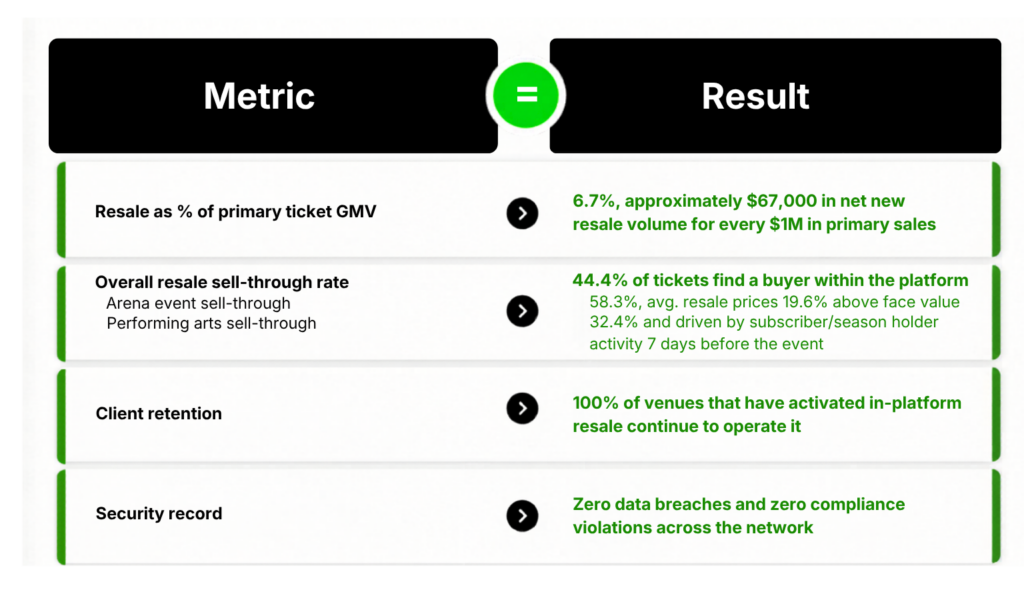
These results come from venues that made the decision to treat resale as an asset and built the right infrastructure to match.
What good resale governance looks like
Bringing resale in-platform does not mean opening an uncontrolled marketplace. The most effective implementations are tightly governed, with venues setting clear rules that reflect how their events operate.
The controls that matter most:
- Pricing rules. Venues can cap resale prices at face value, allow market-driven pricing within a defined ceiling, or set custom price floors and caps by event type, ticket category, or section. Fixed fees work well for GA inventory; percentage fees apply more naturally to premium or variable-price seats.
- Eligibility. Not every event or ticket type needs to participate. Venues choose which events, categories, and sections are eligible, and can apply different rules to each.
- Activation windows. Resale can open and close on a configurable schedule. For example, opening 30 days before an event and closing 2 hours before doors open, with the ability to adjust timing by event type.
- Quantity limits. Per-account listing caps prevent bulk or speculative behavior, keeping the resale market genuinely fan-to-fan.
- Automatic rule enforcement. Rules apply automatically based on event metadata: category, venue, date, and ticket type. Configure the policy once; the system enforces it consistently across every event on the calendar.
The result is a resale environment that reflects your values, protects your audience, and operates at scale without adding manual work to your team.
Ready to bring resale inside your platform?
accesso ShoWare℠ now offers official, fan-to-fan resale built natively into your ticketing environment, delivered in partnership with menta tech, the official resale infrastructure partner for accesso. No development work, no upfront cost, and live within two weeks.
Download the “How to Run Official Resale Inside Your Platform” guide for a step-by-step breakdown of how it works, what you control, and how to get started.

Already an accesso client? Contact your CSM to activate resale for your events. New to accesso? Request a demo to see what accesso ShoWare℠ can do for your venue.