



813,000 remarks. 14 years of data. One clear picture of where visitor experience stands and where it’s heading.
Museums and cultural institutions consistently earn some of the highest ratings in the visitor attractions industry. But that strength comes with a blind spot: the institutions best positioned to act on visitor feedback are, by a wide margin, the least likely to be listening.
That’s one of the sharper findings in accesso’s Voice of the Visitor 2026 Benchmark Report, a study of 813,000 individual visitor remarks drawn from 500 attractions across 37 countries and 14 years of sentiment data. For museum and cultural sector professionals, the report is both a validation and a challenge.
Museums lead the industry in visitor satisfaction
The data confirms what most sector professionals feel intuitively: visitors arrive with curiosity and openness, and museums earn genuine affection when they deliver. History and cultural institutions earn an average rating of 4.62 out of 5, with 78.4% five-star reviews, art museums sit at 4.60 and science museums at 4.50. For context, the industry-wide average is 4.18.
Joy is the dominant emotion in museum visits at 60.8% of the remarks. When the experience lands deeply, visitors will recommend you, intend to return and describe feeling genuinely moved. That loyalty loop is the sector’s greatest asset.
What sends visitors away happy?
Five-star visits follow a recognizable pattern. The hierarchy is consistent across the dataset: people first, then content, then value, then convenience.
- Staff friendliness is positive 89.2% of the time it’s mentioned and the most reliably joy-generating topic in the data. Warmth, expertise and genuine helpfulness are what visitors remember and repeat.
- Kid appeal is the single most positively polarized topic in the entire dataset at 94.6% positive. When children have a great visit, the adults tend to give five stars.
- Emotional impact is the fastest-growing positive topic in the entire study, up 0.42 points in two years. Visitors are increasingly articulating moments of awe, wonder and connection, and rewarding the experience with their highest ratings.
- Staff knowledge and expertise rank among the top positive topics at 78.8%, a particularly meaningful signal for cultural institutions, where interpretation and depth are core to the experience.
The loyalty flywheel spins when these elements align: visitors who feel the visit was worth their time will recommend you (17,865 remarks in the dataset), express intent to return (9,943) and describe emotional impact (5,859). That cascade is the mechanism behind long-term audience growth.
What puts a visit, and a reputation at risk?
The one-star visit is defined by three forces colliding: people problems, operational friction and value destruction. Each has a distinct profile.
Professionalism is the most negatively skewed topic in the entire dataset.
When visitors mention staff professionalism, it’s negative 85.1% of the time. This is distinct from friendliness. Visitors clearly separate warmth from competence and perceived incompetence or disrespect produces a different, more lasting reaction. The report describes it as “nearly unrecoverable.”
Value perception is a paradox.
Ticket prices carry 77.3% negative sentiment. Overall, affordability is 75.4% negative. And yet “worth”, whether the visit was worth the money, is 67.7% positive. Visitors think you’re expensive and worth it simultaneously. That gap is a storytelling opportunity, not a pricing problem.
Queuing is the industry’s fastest-growing pain point.
Conversation share doubled from 1.46% in 2023 to 2.90% in 2025. Crowding complaints are up 0.83 points. The booking experience is also negatively rising. This means the friction now starts before visitors even walk through the door.
The signal most cultural institutions are missing
Here is where the data gets uncomfortable for the cultural sector.
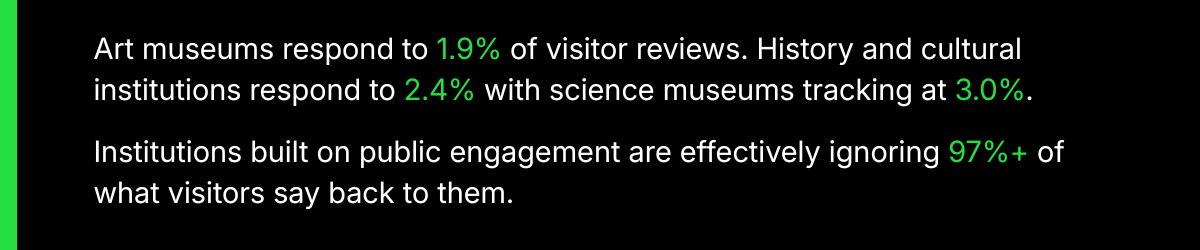
The industry overall replies to just 9.6% of reviews. But the contrast is starkest for cultural institutions. The immersive experience sector, which competes directly with museums for leisure time and cultural curiosity, responds to 28.4% of reviews within 12 days. For museums operating in an increasingly crowded attention landscape, the response gap is also a positioning gap.
The data makes this paradox clear: museum visitors are largely satisfied, thoughtful and willing to share. Their reviews go almost universally unanswered.
These findings are a starting point.
The full Voice of the Visitor 2026 Benchmark Report goes considerably further, covering:
- The complete sentiment breakdown across all 16 attraction segments with benchmarks by category, geography and segment.
- The COVID recovery arc: how visitor expectations shifted before, during and after the pandemic, and where the industry still hasn’t recovered.
- Rising signals: the topics gaining fastest momentum in visitor conversation and what they mean for future planning.
- The anatomy of a five-star visit and a one-star visit, with the specific topics and emotions that define each.
- The response gap analysis: reply rates, response times and how the best operators are closing the loop.
- A 10-point action plan built specifically for attraction operators, grounded in the data.
The Voice of the Visitor 2026 Benchmark Report covers every attraction segment, every emotion and every lever operators can pull to improve the visitor experience and grow revenue.
